
NECS
DEVELOPMENT KITS
DEVELOPMENT KITS
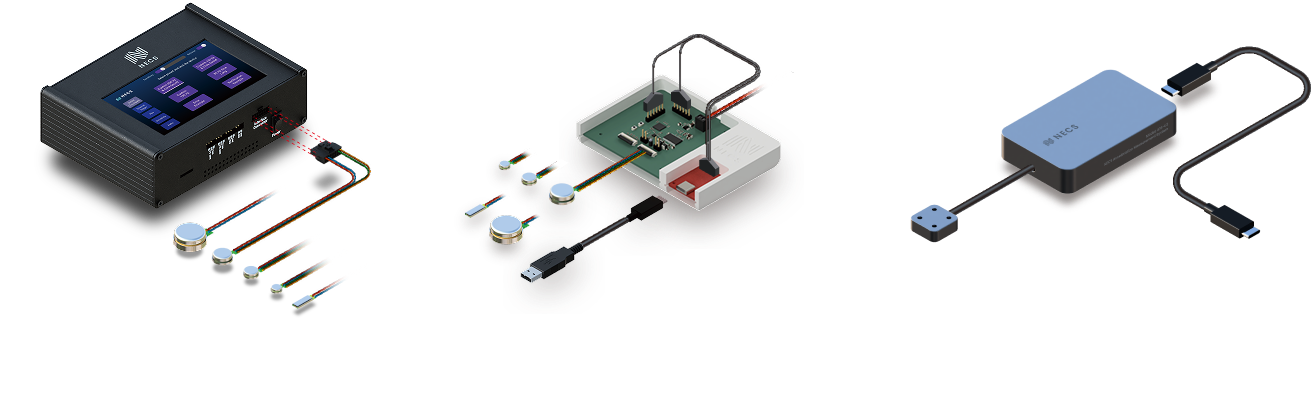
NECS provides signal-input and vibration-measurement tools for haptic designers.
Inputting a Variety of Vibration Patterns
RMA is an actuator that can generate a wide range of vibration patterns by utilizing the full frequency spectrum, rather than producing only simple vibration patterns within a specific resonant-frequency band. To help users maximize these advantages of RMA, NECS provides Development Kit 1 and Development Kit 2, which enable input of various signal types.
Quantitative Measurement of Haptic Results
One of the challenges haptic design engineers face is that it is not easy to quantitatively analyze haptic vibration results. The G-force data provided by actuator suppliers represents the G-force of the actuator as a standalone unit, not the value measured in the assembled state when the actuator is mounted in a device. As a result, during development, many haptic design engineers rely on qualitative evaluation based on the tactile feel transmitted to their fingertips when assessing vibration performance of the assembled set. Quantitative vibration measurement also requires expensive vibration measurement equipment, which can be inconvenient. NECS offers its in-house developed, developer-focused mobile G-force meter at a reasonable price.
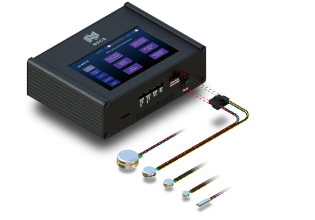
Development Kit 1 (D-Kit-1)
Development Kit 1 is designed for quick, intuitive evaluation of haptic actuator performance and easy prototyping across a wide range of environments.
Key Features
- Signal selection and vibration intensity adjustment are possible using touch-based buttons.
- Communication functions with the MCU are provided so that users can add WAV or MP3 files they have created themselves.
- The MCU can be accessed via a Wi-Fi network, and communication is possible using simple tools like PuTTY or WinSCP.
- Button settings can be added or changed with simple code modifications.
- In the button setting code, you can freely modify the button title and the linked WAV or MP3 file.
Development Kit 2 (D-Kit-2)
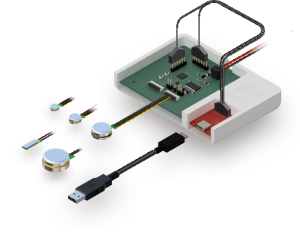
Development Kit 2 is designed to support the development and demonstration of haptic feedback systems using NECS haptic actuators. Compared with Development Kit 1, D-Kit-2 offers greater flexibility for haptic signal input and provides configurable input-sensing settings.
Key Features
- Built on Infineon PSoC™ 4100S Plus and TI DRV2511
- Scilab-based .wav-to-PWM conversion
- Actuation/Sensing function support
Input Sensing
What is Input Sensing? Input Sensing is a technology that detects press-and-release actions on the haptic surface by measuring voltage changes generated in the sensing coil.
The following parameters can be adjusted in Development Kit 2:
- Press Threshold
- Release Threshold
- Release Ratio
- Minimum Delay
- ADC LSB Size
G-Force Meter (D-Kit-3)
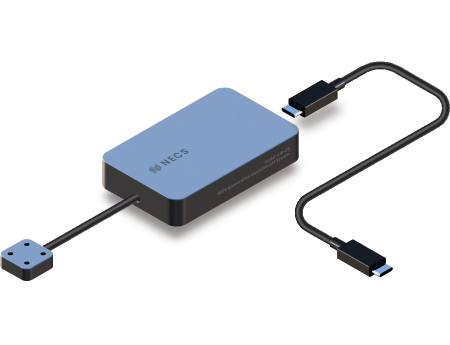
The NECS G-Force Meter was developed to help haptic development engineers in their design work. Haptics fundamentally involves generating vibration in the target device. Haptic engineers create fine-tuned vibration patterns to deliver an improved tactile experience, and they also design and test distinct vibration modes to represent different situations.
The NECS G-Force Meter is a developer-focused measurement instrument that makes it easy to quantify vibrations delivered to a user’s fingertips or other body parts. It converts the vibrations generated by various designed input signals into clear, measurable data.